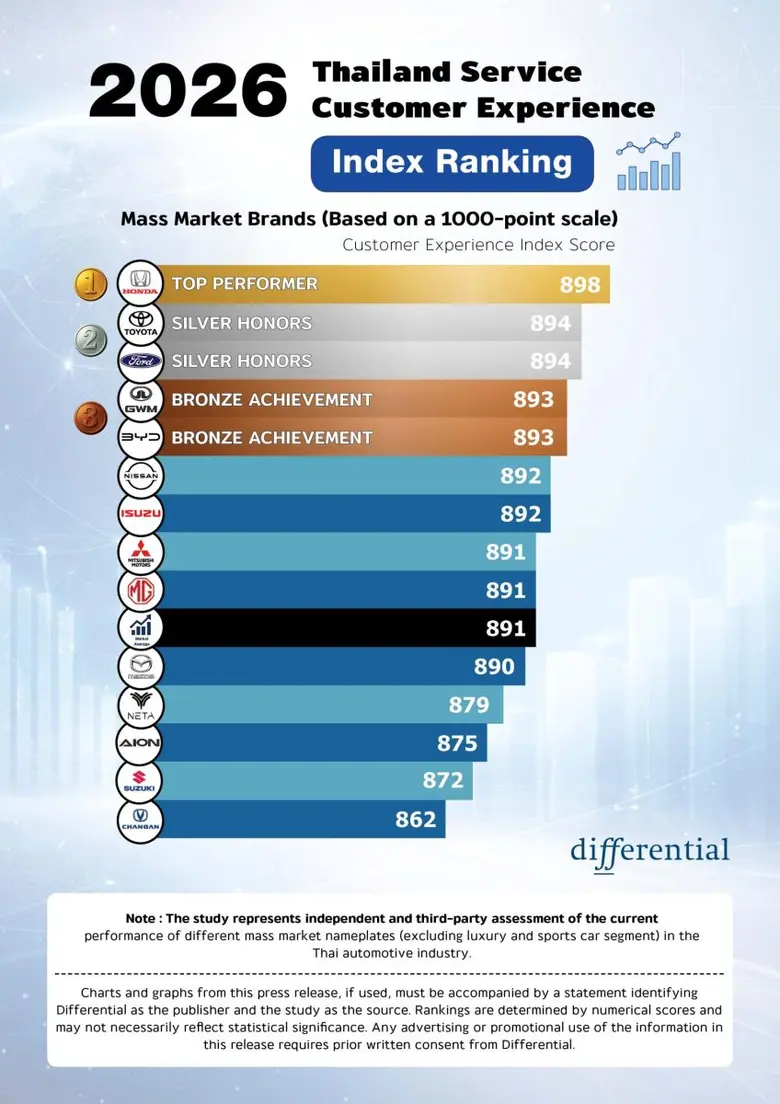
As part of its year-over-year benchmarking, the study provides valuable insight into shifting customer expectations and emerging brand performance trends, equipping passenger vehicle manufacturers to refine and strengthen their after-sales strategies. Conducted between October and December 2025, the research gathers feedback from vehicle owners who visited authorized service centers within ten months prior to the interview date for routine maintenance or repair during their first 12 to 36 months of ownership. Satisfaction is measured across five key dimensions, ranked by importance: service quality, price and value, personnel and facilities, communication and transparency, and convenience and accessibility.
Key Industry Insights:
- The overall Service CXI declines by two points in 2026, underscoring the growing challenge brands face in meeting and exceeding increasingly elevated customer expectations in after-sales service. Honda ranks highest with 898 points, advancing eight points year over year, driven by enhancements in structured service processes and clearer customer communication. Toyota (-3 points), Ford (-2 points), and GWM (-2 points) record slight decreases yet remain among the top-performing brands. BYD ranks second with 893 points, improving four points from 2025, supported by stronger perceptions of service quality and improved performance in Price & Value perceptions. GAC Aion and Changan appear in the rankings for the first time; both score below the industry average, highlighting execution gaps as their service networks continue to develop and mature.
- The 2026 findings indicate a broad softening in performance across four dimensions—Service Quality, Personnel & Facilities, Communication & Transparency, and Convenience & Accessibility—highlighting increasing pressure on operational consistency. Declines are observed in areas such as technical competence perception, quality of repairs, progress updates, service advisor openness, and cost transparency. Facility-related attributes, including service hours, amenities, and waiting area comfort, also trend downward, suggesting that customers are raising their benchmarks for both technical execution and overall service environment.
- While more than 80% of customers continue to prefer booking appointments through dealer reminder phone calls, the highest satisfaction levels are reported among those using OEM mobile applications, followed by chat-based communication with dealers. The study also reinforces the importance of sustained post-service engagement: customers who receive continuous and proactive follow-up—beyond a single contact after service—report stronger satisfaction and a greater sense of connection with the dealership.
"Achieving excellence in after-sales service requires automotive manufacturers to focus on three key priorities. First, ensure consistent execution throughout the service journey, with first-time-right repairs, clear completion timelines, and professional communication from service advisors, as even small inconsistencies can now affect customer satisfaction. Second, promote transparency through structured consultation, offering clear, itemized quotations, straightforward warranty explanations, and proactive progress updates to build trust and a sense of fairness. Third, enhance engagement through multi-channel touchpoints, utilizing OEM apps, chat platforms, and proactive follow-ups beyond a single interaction to strengthen customer retention and foster long-term loyalty," said Siros Satrabhaya, Managing Director at Differential, Thailand.
About the Study
The 2026 Thailand Service CXI StudySM is an independent evaluation of customer satisfaction with authorized automotive service networks in Thailand. Covering 12 mass-market brands, the study is based on 2,651 respondents across Thailand who purchased their vehicles between October 2022 and November 2024 and had them serviced between December 2024 and December 2025.
By providing detailed benchmarking data, competitive performance insights, and customer sentiment analysis, the study serves as a critical tool for automotive executives seeking to enhance after-sales strategies.
Unlock the Full Report for Competitive Advantage
The full 2026 Thailand Service CXI StudySM provides deep insights into:
- Brand-specific performance and customer satisfaction trends
- Benchmarking against competitors in key service areas
- Actionable strategies to improve after-sales service and engagement