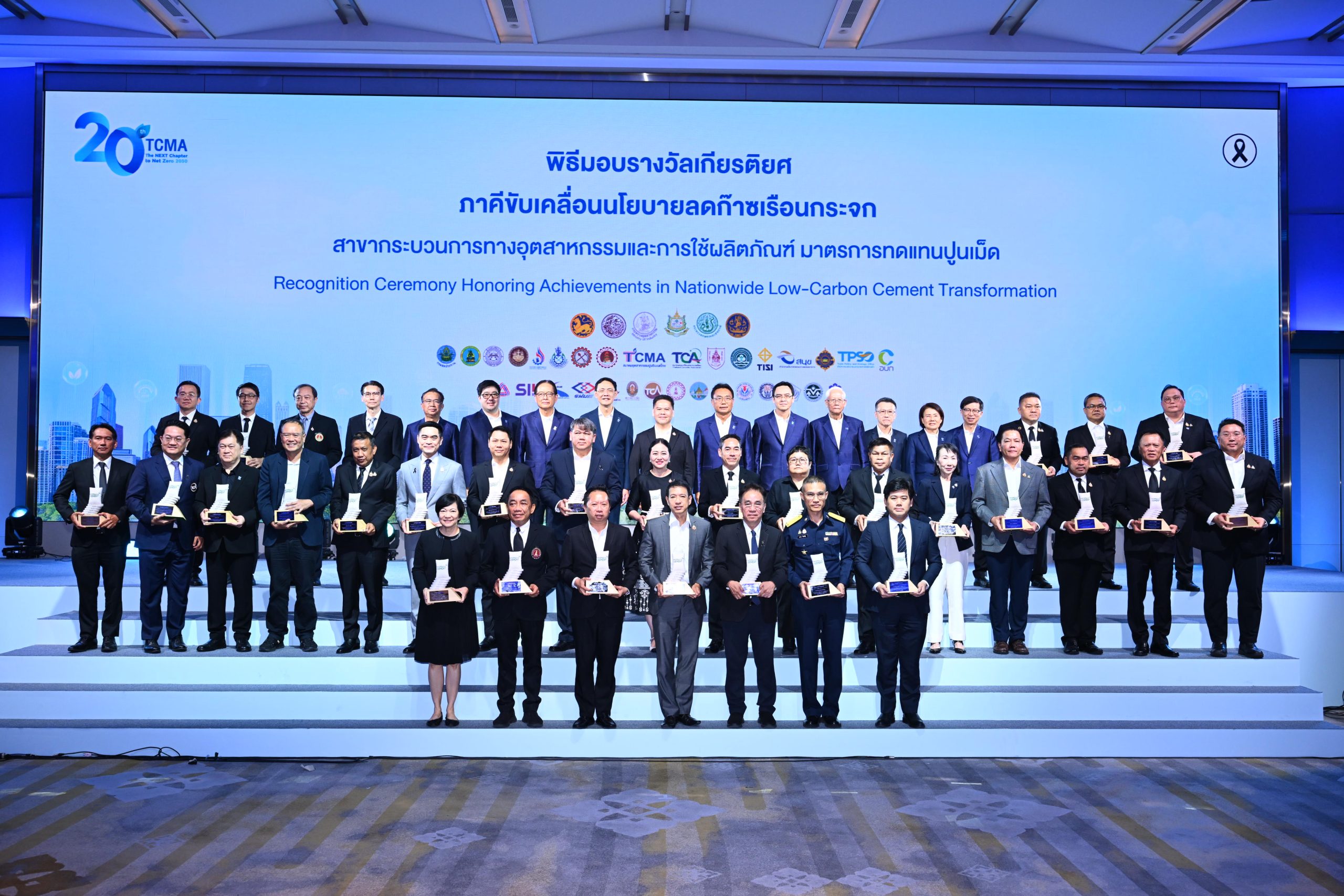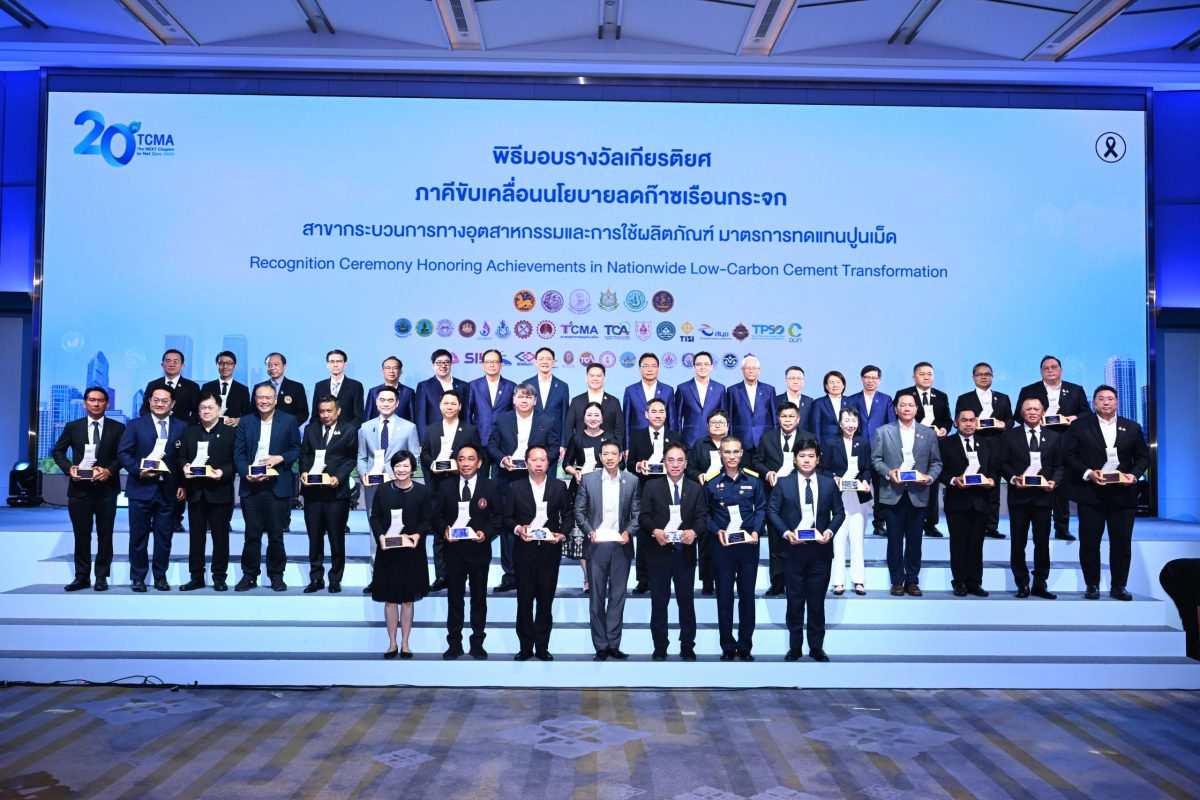
The achievement was formally recognized at the "TCMA at 20: The Next Chapter to Net Zero" event, where H.E. Mr. Varawut Silpa-archa, Minister of Industry, presided over an award ceremony honoring 34 implementing partners, supported by six ministries, for their collective contribution in driving policy into practice.
H.E. Mr. Varawut stated that the success of clinker substitution reflects the strength of multi-stakeholder collaboration across government, industry, academia, and professional bodies, enabling Thailand to accelerate greenhouse gas reduction while advancing green industry transformation and competitiveness.
"Greenhouse gas reduction becomes possible when all sectors work together; from policy and technology to real-world implementation. The success of clinker substitution is a tangible example of collaboration delivering real impact, and marks an important step toward Thailand's Net Zero 2050 ambition." H.E. Mr. Varawut said.
Mr. Surachai Nimla-or, Chairman of Thai Cement Manufacturers Association (TCMA), highlighted that the results were made possible through close coordination across sectors, driving national policy into implementation through R&D, standards development, technological advancement, and market adoption mechanisms.
"The reduction of over 3.8 million tonnes of CO? equivalent reflects the collective effort of all sectors in operationalizing national measures. The cement industry remains committed to advancing the transition toward a low-carbon economy." Mr. Surachai said.
A key driver behind this success is the development and widespread adoption of hydraulic cement (low-carbon cement), which reduces the clinker content - the most carbon-intensive component in cement production - while maintaining performance and structural integrity in accordance with Thai Industrial Standard TIS 2594. Today, hydraulic cement is extensively used across the country in infrastructure projects, public buildings, industrial facilities, and residential construction, marking a systemic shift from alternative material to mainstream low-carbon construction solution.
Performance data underscores the pace of progress. In 2021, clinker substitution delivered over 300,000 tonnes of CO? reduction, achieving results nine years ahead of the NDC schedule. Between 2022-2023, an additional over 1 million tonnes of CO? reductions were realized. Cumulatively, from 2019 to present, emissions reductions have exceeded 3.8 million tonnes CO? equivalent.
This progress has been enabled by an integrated effort among 34 implementing partners, with policy and institutional support from six ministries, covering policy formulation, standards development, market promotion, and enabling mechanisms; underscoring the role of public-private partnership (PPP) in driving systemic transition.
Mr. Surachai further noted that the clinker substitution initiative represents a scalable model of translating national climate ambition into implementation, with potential for replication across other industrial sectors and expansion into regional collaboration frameworks.
"Hydraulic cement today is not only a low-carbon material; it is part of Thailand's broader transition toward sustainable growth. It demonstrates that with strong collaboration, emissions reduction is not only possible, but achievable at scale." Mr. Surachai said.
The success of clinker substitution reinforces Thailand's leadership in industry-led climate action, highlighting how coordinated public-private efforts can deliver tangible emissions reductions while strengthening industrial resilience. It marks a critical step toward achieving Net Zero 2050, and offers a replicable model for industrial decarbonization at both national and regional levels.