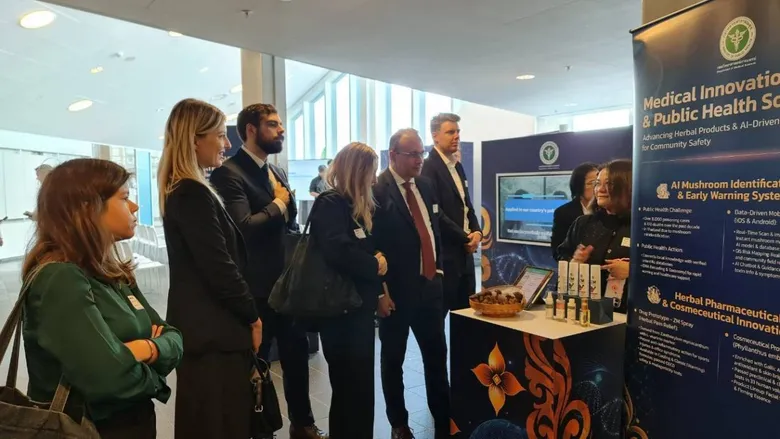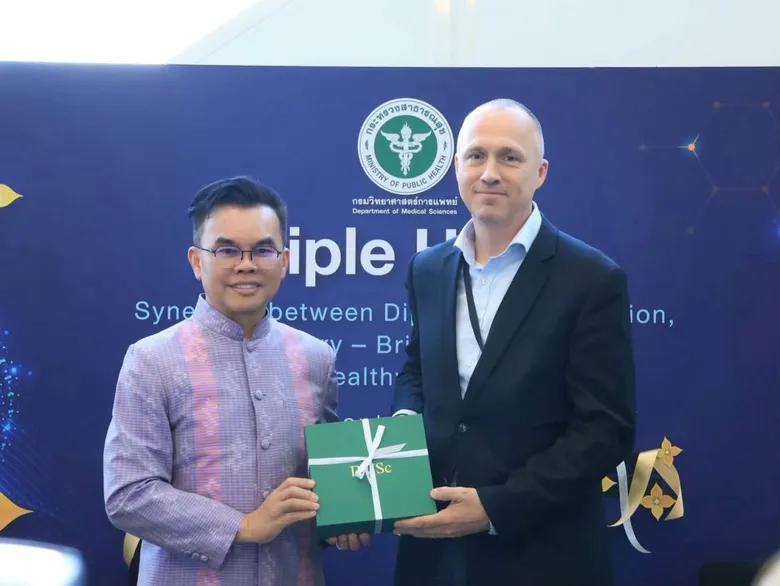
The event was held at UN City, Copenhagen, under the conceptual framework "Synergies between Diplomacy, Innovation, Industry — Bridging Innovation for Healthy Longevity." Opening remarks were delivered by Dr. Corinne Capuano, Director of Programme Management, WHO Regional Office for Europe, with the event formally opened by H.E. Mrs. Suphanvasa Chotikajan Tang, Ambassador of Thailand to Denmark.
The Thai delegation, led by Dr. Sarawut Boonsuk, Director-General of the Department of Medical Sciences, delivered a keynote address titled "From Lab to Life: Sciences for Healthy Longevity," outlining DMSc's and the Ministry of Public Health's mission to help the Thai population live longer, healthier lives. The keynote showcased Thailand's work in ATMPs, Thai herbal medicine, and cosmetics, while seeking research collaboration and investment partnerships with international counterparts. The delegation subsequently engaged with Danish public and private-sector health networks and visited Healthcare Denmark to study the country's integrated health innovation ecosystem connecting government, academia and industry.
Key Discussion Highlights
Discussions underscored that funding constraints for large-scale clinical trials remain a major bottleneck for health research worldwide. One proposed solution is the accelerated use of precise biomarkers to shorten trial timelines, particularly in longevity research. Thailand's agricultural base was identified as a distinct strength, with the potential to convert byproducts and biomass — such as sugarcane bagasse and cassava — into bioactive compounds for the pharmaceutical and medical industries.
On investment, Thailand offers concrete enabling mechanisms, including tax incentives from the Board of Investment (BOI) and the Eastern Economic Corridor (EEC), alongside a proven public-private model exemplified by Novo Nordisk's clinical research collaboration with a Thai public hospital on non-communicable diseases (NCDs). Thailand's position as a gateway to ASEAN, with a market of over 600 million people, was also highlighted. Priority areas for further development include regulatory clarity and health data infrastructure. Participants proposed establishing a cross-border regulatory sandbox with SMEs and international industry partners, and positioning Thailand as a wellness destination, building on the success of the Global Wellness Summit in Phuket.
As part of the mission, the Thai delegation also showcased Thai herbal products, safe/healthy food, and traditional Thai massage, presenting Thailand's approach to preventive medicine and healthy living to an international audience — including medicinal foods such as turmeric and galangal — as cultural assets that reinforce Thailand's position as a regional wellness hub.
From Better Healthcare to a High-Value Health Economy
A central ambition of the partnership is to move beyond a conventional disease-treatment model toward a comprehensive approach encompassing disease prevention, precision diagnostics, personalized medicine, biotechnology, digital health, and healthy longevity.
This approach holds significant potential to advance Thailand's health economy — through the development of medical technologies and products, the commercialization of research and intellectual property, attracting international investment, and connecting Thai private-sector innovators with European markets and networks.
Looking ahead, the partnership can expand into joint research programmes, reference laboratory networks, scientist and expert exchanges, technology transfer, and shared medical innovation testing platforms — accelerating the translation of research into products and services that generate real impact for the public and the economy.
This cooperation marks an important step toward building a "Global Partnership for Advanced Medicine and Better Lives," strengthening Thailand's medical-science capabilities while fostering an ecosystem conducive to innovation, investment, and the future health industry.
The goal is not simply to help people live longer — but to help them live longer in good health, transforming medical knowledge and innovation into a sustainable driver of Thailand's economy and quality of life.