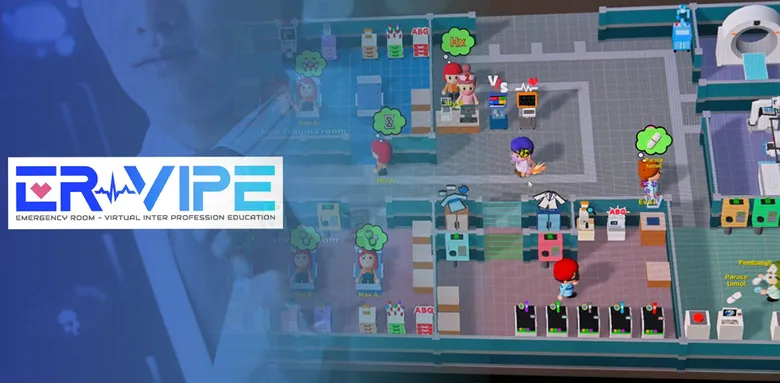
ER-VIPE is integrated into the Interprofessional Collaboration for Patient Safety course held at the Chulalongkorn Healthcare Advanced Multi-Profession Simulation Center. Players assume different professional roles through avatars and work as a team to triage and treat diverse cases under strict time limits. Although game-based, the training emphasizes serious skill-building: leadership, clear communication, mutual support, and situational awareness, based on TeamSTEPPS—an internationally recognized framework for improving patient-safety outcomes.
Asst. Prof. Dr. Khuansiri Narajeenron, the creator of ER-VIPE, stresses that strong clinical skills alone are not enough. "If we don't communicate or see the bigger picture, medical errors will occur," she said, noting that collaborative thinking remains a global challenge in healthcare. Research from the program shows improved teamwork, reduced stress, better communication, and increased resilience among students who train with ER-VIPE.
The platform was developed through interdisciplinary collaboration, including Architecture, Engineering, and Communication Arts, to accurately map emergency-room workflows. ER-VIPE currently features three patented scenes: a COVID-era respiratory-failure case, cardiac ischemia requiring resuscitation, and a crowded ER scenario emphasizing patient flow, prioritization, and cross-disciplinary coordination. National-level gamers, pre-clinical students, and even administrators have been able to use the system after a brief orientation.
The training has expanded beyond undergraduates to include first-year medical residents, graduate students, and multidisciplinary hospital staff. The program has demonstrated significant benefits, including shifts from "silo thinking" to system-based thinking and measurable reductions in treatment errors. Interest has also grown among rural-doctor training programs, highlighting ER-VIPE's potential to support nationwide healthcare development.
A fourth scene—focused on accidents in older adults, including ethical considerations and AI-based soft-skill assessment—is now underway with support from the Chulalongkorn Innovation Fund. Expected to be completed this year, it will be the world's first simulation of its kind.
Ultimately, ER-VIPE aims to cultivate healthcare teams who communicate better, think together, and deliver safer, more effective care.
Read the full article at https://www.chula.ac.th/en/highlight/276022/