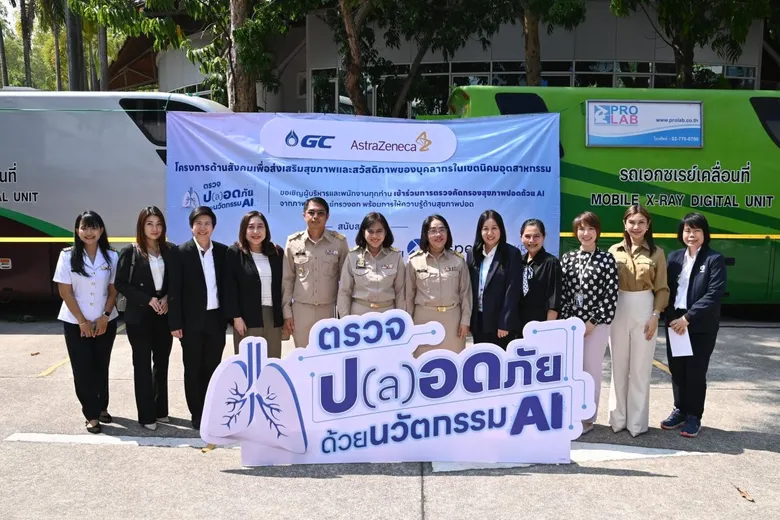
Dr. Sumet Tangprasert, Governor of the Industrial Estate Authority of Thailand (IEAT), said, "The IEAT is committed to developing Thailand's industrial estates into leading economic zones while safeguarding the environment and quality of life, in line with the Eco-Industrial Town development approach. In conjunction with AstraZeneca (Thailand) Ltd., the Department of Labor Protection and Welfare (DLPW), and the Social Security Office (SSO), we have launched the Health and Well-being Enhancement Program for Workers in Industrial Estates. This initiative offers free AI-assisted lung screenings to workers in Sa Kaeo, Chonburi, Rayong, and Bangkok, while educating them on respiratory care. This is the starting point for a 'systemic collaboration' to develop an empirical workforce health database. This data will further support policies and healthcare guidelines tailored to local needs, strengthening the Thai workforce's healthcare system sustainably."
Ms. Somrasa Pongpermpruek, Corporate Affairs Director of AstraZeneca (Thailand) Ltd., stated, "AstraZeneca is committed to improving healthcare through science and technology. We are eager to work in orchestration with public and private sector alliances to raise the quality of life for Thai people. For this field project, we collaborated with GC and SCG to provide preventive health services and access to AI-assisted lung screenings with precision and efficiency. Meanwhile, we are encouraging greater awareness of lung care and appropriate screening so that diseases or risk conditions can be detected at an early stage when there are no symptoms. As a result, patients can receive timely treatment, increasing the opportunity for a definitive cure."
In addition to screenings, a talk session titled "Healthy Lungs: Early Detection, Timely Treatment" was held to raise awareness about proactive screening and risks such as PM2.5. Early detection of conditions like COPD and lung cancer can significantly reduce severity while boosting a patient's quality of life.
Dr. Piamlarp Sangsayunh, Pulmonologist, Central Chest Institute of Thailand stated, "The danger of PM2.5 lies in its ability to penetrate deep into the respiratory system, reaching the alveoli and even entering the lymphatic system or bloodstream. When these particles enter the lungs, they trigger inflammation, causing the body to repair itself in a way that leads to fibrosis. Long-term, this can cause chronic diseases such as emphysema or Chronic Obstructive Pulmonary Disease (COPD). Furthermore, PM2.5 can trigger acute exacerbations of pre-existing conditions like asthma."
Dr. Passakorn Wanchaijiraboon, medical oncologist at Prapokklao Hospital, Chanthaburi added, "Lung cancer is the second most common cancer in Thailand but remains the leading cause of death, claiming twice as many lives as other cancer types. Incidence is rising due to factors such as PM2.5, cigarette smoke, and carcinogens; notably, even non-smokers and young people can develop the disease. A major challenge is that many patients are diagnosed at an advanced stage, which significantly reduces treatment success. However, if detected in Stage 1, the five-year survival rate is as high as 92%. Consequently, regular screening is vital. Low-dose CT scans offer high precision in detecting early abnormalities, while AI technology—operating under physician supervision—increases the speed and accuracy of identifying abnormalities that may be invisible to the naked eye."
Actress Pornthip "Aey" Skidjai shared her experience being diagnosed with Stage 1 lung cancer: "I've always taken care of my health—sleeping 8-10 hours a day, exercising 3-4 times a week, never smoking, and wearing face masks. I never thought I was at risk. The discovery happened during a checkup when a low-dose CT scan showed a small shadow. When follow-ups showed the spot had grown, I had surgery. The biopsy confirmed Stage 1A1 lung cancer. Because it was caught early, I had a 90% chance of recovery through surgery alone, without having to take further medication. Initially, I admit I was in shock. I urge everyone to take good care of their health, get regular checkups, and be aware of risk factors such as dust and smoke. Early detection can significantly increase the chances of a complete cure."
The "Lung Screening with AI Innovation" activity provided screenings for 1,400 workers from GC and SCG. The process included a COPD risk assessment and AI-assisted chest X-rays using Inspectra CXR technology from Perceptra, a Thai health-tech startup. This technology can flag eight different lung conditions with an accuracy of 98.9% and reduces the time required to interpret preliminary results by up to 70%, thereby enabling faster detection at an early stage with greater precision.